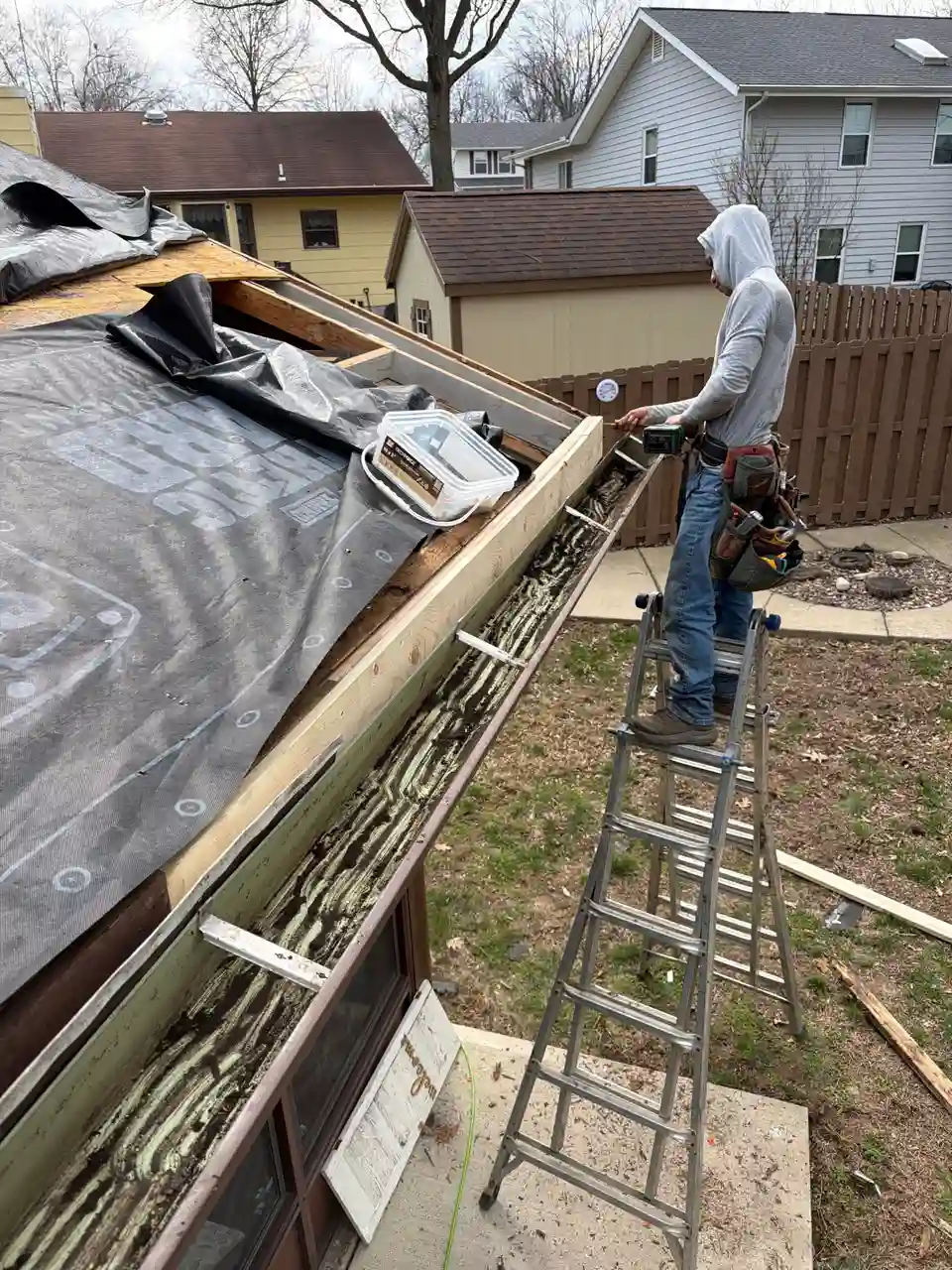
Seamless aluminum gutters typically cost $8 to $16 per linear foot installed in Missouri, so a common 150 to 200 foot ranch runs $1,500 to $3,500 including downspouts. They cost more than sectional gutters because they are formed on site from a continuous coil, but with no joints every ten feet there is nowhere for them to leak or pull apart.
Below: what goes into the price, how to size gutters for the roof you actually have, why the downspouts matter more than the gutters, and the questions that separate a good installation from one that overflows next spring.
Seamless vs sectional
Sectional gutters come in 10-foot lengths that are snapped or screwed together with sealed connectors. Every connector is a joint, every joint depends on sealant, and every sealant fails in a few years of Missouri freeze-thaw. Joints also catch debris and start clogs.
Seamless gutters are extruded on site from a roll of aluminum coil through a portable machine, cut to the exact length of each run. The only seams are at corners and downspout outlets. The result is fewer leaks, a cleaner line along the fascia, and gutters that stay put because they are hung with hidden hangers screwed into the fascia every two feet rather than spikes driven through the front.
Sectional still has a place: a detached shed or a DIY budget. On a house, seamless is the standard for good reason.
What seamless gutters cost
- 5-inch seamless aluminum: $8 to $13 per linear foot installed.
- 6-inch seamless aluminum: $10 to $16 per linear foot installed.
- Downspouts: $8 to $15 per linear foot; a two-story home needs more.
- Steel or copper: steel adds 30 to 50 percent; copper is $30 to $50 per foot and is a design choice more than a drainage one.
- Removal and disposal of old gutters: $1 to $2 per foot.
- Fascia repair: if the board behind the gutter is rotten, it must be fixed first. See our soffit and fascia guide for what that costs.
Color adds little or nothing; most coil comes in 20 or more stock colors. What moves the price is footage, the number of corners and downspouts, roof height, and whether the fascia needs work.
Sizing: 5-inch or 6-inch?
Five-inch K-style is the residential default and handles most roofs. Six-inch carries about 40 percent more water and is worth the small upcharge when:
- The roof is steep. Water comes off a 10/12 pitch fast enough to shoot past a 5-inch gutter in a downpour.
- A large roof area drains to one run, such as a long rear eave collecting two slopes and a dormer.
- The house has a metal roof, which sheds water and snow much faster than shingles.
- You want gutter guards; the bigger trough loses less capacity to the screen.
The honest math is roof square footage, pitch, and local rainfall intensity per run. Warren County sees short, intense summer storms, which is the case where capacity matters. A contractor should be able to explain which runs on your house are marginal at 5 inches rather than quoting one size for everything.
Downspouts and drainage
Most gutter failures are downspout failures. Rules that hold up:
- One downspout for every 30 to 40 feet of gutter, and at least one per run.
- Use 3x4-inch downspouts instead of 2x3. They move roughly twice the water and clog far less on leaves and shingle grit.
- Discharge at least 4 to 6 feet from the foundation, with extensions, splash blocks, or buried drain lines. A downspout dumping at the corner of the house is how basements get wet and how the soil under the footing moves.
- Pitch the gutter about a quarter inch per 10 feet toward the outlet. Too flat and it holds water; too steep and it looks crooked and shortens the fascia cover.
If the old gutters overflowed at the same spot every storm, that spot needs an additional or larger downspout, not just a new gutter. This is also where roof and gutter overlap: a missing drip edge sends water behind the gutter no matter how well it is hung, and a roof leak at the eave will show up as a wet fascia. Our roof leak guide covers the eave-edge failures that mimic gutter problems.
Are gutter guards worth it?
Under trees, usually yes; on an open lot, often not. Micro-mesh guards keep out leaves, needles, and shingle grit and cost $10 to $30 per foot depending on the product. Cheap plastic screens from the hardware store keep leaves on top of the gutter and let seeds and grit through, and they are the ones you see bowed and clogged. Guards do not eliminate maintenance; they change it from cleaning the gutter to brushing off the guard, and they reduce the ice-dam risk of a gutter packed with wet leaves in November. Pair guards with 6-inch gutters and 3x4 downspouts so the system still has capacity when the mesh is partly covered.
What a good installation looks like
- Hidden hangers with screws every 24 inches into sound fascia; no spikes and ferrules.
- Gutter tucked behind the drip edge, or a drip edge added, so water cannot run behind the gutter.
- Sealed corners and outlets with a quality gutter sealant, and end caps crimped and sealed.
- Downspouts strapped to the wall, elbows sealed, extensions or drains at grade.
- Fascia inspected and repaired before hanging anything on it.
A&S Contracting Services installs seamless aluminum gutters and handles the fascia, soffit, and roofing edge as the same crew, so the roofline gets sorted once. Our gutter services cover Warrenton, Wright City, Troy, Wentzville, Washington, Foristell, Jonesburg, and the rest of our 50-mile service area with free written estimates.
Gutters overflowing or pulling loose?
A&S Contracting Services forms seamless aluminum gutters on site and fixes the fascia behind them in the same visit. Free written estimate anywhere within 50 miles of Warrenton.
Call (636) 359-7204Frequently asked questions
How long do seamless aluminum gutters last?
Twenty to thirty years with basic cleaning, longer if the fascia stays sound and the hangers were screwed rather than spiked. Sealant at corners and outlets typically needs attention every 8 to 10 years.
Can seamless gutters be installed in one day?
Yes, on most homes. The coil is formed on site and each run is hung in one piece, so a typical house is done in a single day including downspouts. Fascia repair or removal of old gutters can add time.
Do I need gutters on every edge of the roof?
Every eave that sheds water, yes. Gable ends do not carry water and do not need gutters. Skipping a rear eave to save money usually shows up later as a wet foundation or rotten fascia on that side.
What is the difference between K-style and half-round gutters?
K-style has a flat back and a decorative front profile, carries more water for its size, and is the standard on modern homes. Half-round is a traditional look for older houses, costs more, and holds a bit less water.