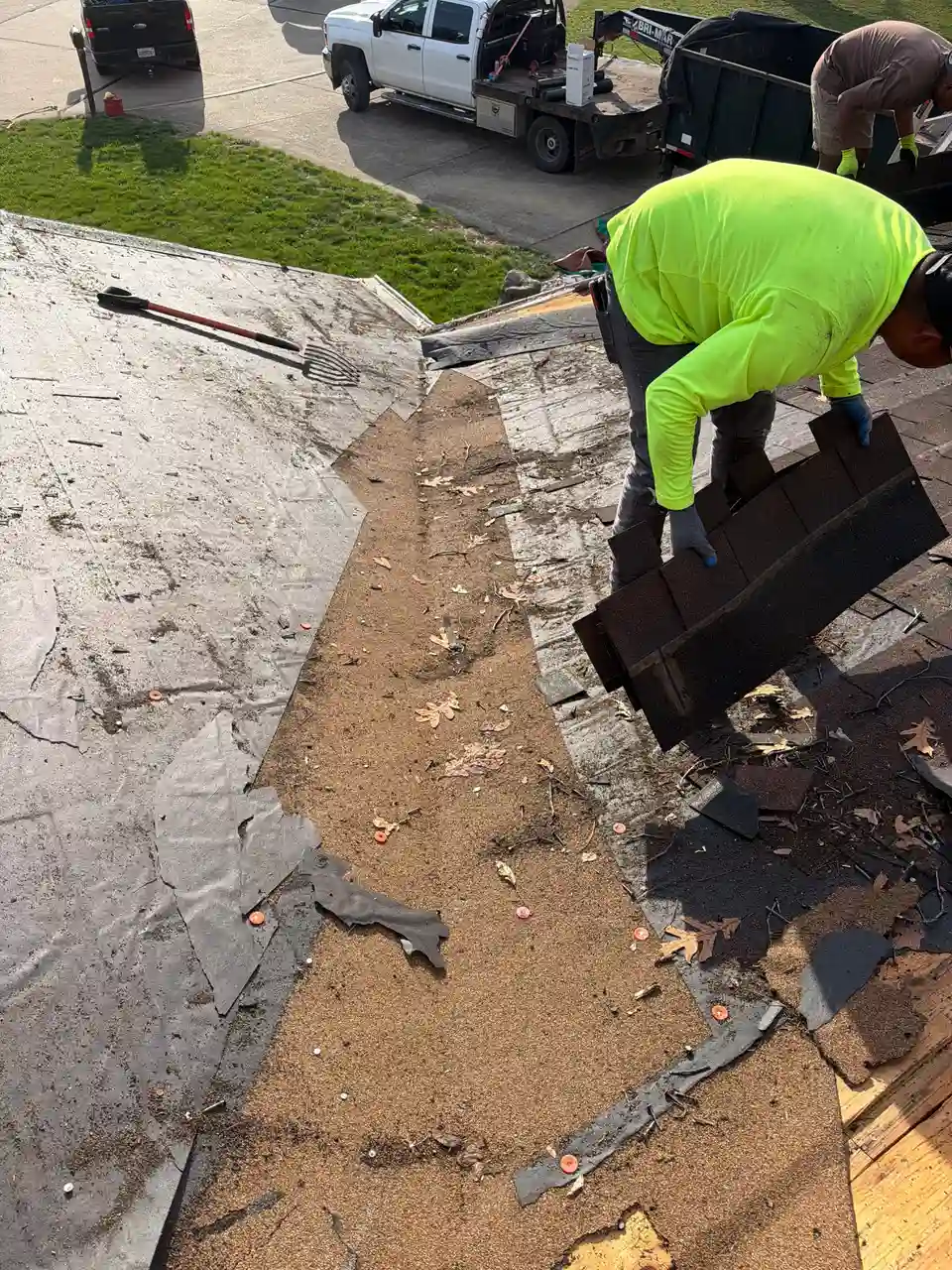
Most roof leaks come from failed flashing, cracked pipe boots, or lifted shingles, not from the spot where the stain shows up inside. Water enters high on the roof, runs along the underlayment or rafters, and drips where it finally finds a gap. A typical single-point repair runs a few hundred dollars; widespread leaks on a roof past 20 years usually mean it is time to price a replacement.
This guide walks through how a roofer actually traces a leak, what you can safely do before help arrives, what repairs cost across Warren County and the surrounding area, and the signs that a patch will only buy you a season.
Where roof leaks actually start
After enough service calls, the same handful of failure points account for nearly every residential leak:
- Pipe boots. The rubber collar around plumbing vents dries out and splits after 8 to 12 years of Missouri sun. This is the single most common leak on asphalt roofs, and one of the cheapest to fix.
- Flashing. Metal at chimneys, sidewalls, and skylights depends on sealant and correct step-flashing. Sealant fails; flashing that was never woven into the shingles fails faster.
- Valleys. Two roof planes meet and concentrate water. Debris, ice, or a shingle cut too short lets water ride under the surface.
- Wind-lifted or missing shingles. Straight-line winds that come through Warren and St. Charles counties every spring break the seal strip; the shingle still looks attached but no longer sheds water.
- Nail pops and exposed fasteners. A nail that backs out lifts the shingle above it and leaves a hole in the one below.
- Ice dams. In a cold snap, snow melts over the warm attic and refreezes at the eave. Water backs up under the shingles. Poor attic ventilation and insulation are the root cause, not the roofing.
Notice what is not on the list: a shingle roof rarely leaks through the middle of a healthy field of shingles. If water is showing up far from any penetration or edge, suspect a nail pop or hail bruising (see our guide to hail damage and insurance claims).
What to do the day you spot a leak
Water damage compounds by the hour, so the first moves are about containment, not diagnosis.
- Catch the water. A bucket under the drip, and a towel or plastic over furniture and flooring.
- Relieve a bulging ceiling. If drywall is sagging with trapped water, poke a small hole at the low point with a screwdriver and let it drain into a bucket. A controlled hole beats a collapsed ceiling.
- Go to the attic with a flashlight. Look for wet insulation, dark streaks on rafters, or daylight. Follow the water trail uphill; the entry point is usually above and upslope of the drip.
- Photograph everything. Stains, wet insulation, the date and weather. If this becomes an insurance claim, the timeline matters.
- Stay off a wet roof. A tarp is reasonable if the roof is dry and low-pitched and you are comfortable up there; otherwise wait. Most roofing injuries happen on quick "just a look" trips.
How roofers find the source
A good leak inspection is methodical. It starts inside the attic, where the entry point is usually visible as a stain or a wet spot on the underside of the decking. From there the roofer walks the roof above that spot and checks every penetration, edge, and transition within about ten feet upslope. On a stubborn leak, a hose test isolates the section: one person runs water on a single area at a time while another watches inside.
What separates a repair that holds from one that fails by next spring is scope. Sealant smeared over a cracked pipe boot looks fixed for a month. Replacing the boot, re-laying the shingles around it, and checking the neighboring boots is a real repair. That is the difference you should expect to see on a written estimate from any roofing contractor.
What roof leak repair costs
Costs vary with access, pitch, and how much roofing has to come up to reach the problem. Typical ranges homeowners in our area see:
- Pipe boot or single flashing repair: roughly $200 to $500.
- Small shingle section (wind damage, a few square feet): $300 to $900.
- Chimney re-flashing: $500 to $1,500 depending on chimney size and whether the counter-flashing is cut into the mortar.
- Valley rebuild: $600 to $2,000.
- Decking replacement where wood has rotted: add $75 to $150 per sheet plus the roofing over it.
Two things move the number more than anything else. A steep or multi-story roof adds staging and time. And a leak that has been ignored for a season often means rotten decking, wet insulation, and water-damaged drywall, which turns a $400 boot replacement into a $1,500 job. If you want to compare a repair against a full tear-off, our Missouri roof replacement cost guide lays out the per-square numbers.
Will homeowners insurance pay?
It depends on the cause. Standard Missouri policies cover sudden, accidental damage: wind tearing shingles off, hail, a tree limb through the decking. They generally exclude wear and tear, meaning a leak from a 25-year-old pipe boot or deteriorated flashing is on you. Interior damage from a covered event is usually covered as well, subject to your deductible.
Because the line between "storm damage" and "old roof" is where most claim disputes live, documentation is everything. A&S Contracting Services documents storm and hail damage with dated photos and a written scope so your adjuster has a clear record. We cannot negotiate with your insurer on your behalf, but we can make sure nothing on the roof gets missed.
Repair or replace?
Repair makes sense when the roof is under about 15 years old, the leak has one identifiable cause, and the surrounding shingles are still flexible with good granule coverage. Replacement is usually the better spend when:
- The roof is past 20 years, or past about 70 percent of its rated life.
- You are on your second or third repair in a few years, in different places.
- Shingles are curling, cracking, or shedding granules into the gutters across the whole roof.
- The decking is soft in more than one area.
- There is already a second layer of shingles. Missouri codes typically allow one overlay, and there is nowhere left to go.
A rule of thumb we use: when repair costs pass about 30 percent of a replacement quote, or the roof will need replacement within three years anyway, put the money toward the new roof. You get a warranty, a clean deck inspection, and one accountable crew instead of a string of patches.
Have a leak right now?
Send us the address and a photo of the stain. A&S Contracting Services schedules leak inspections within days across Warren County and central Missouri, and every estimate is free and written.
Call (636) 359-7204Frequently asked questions
Why does my roof only leak sometimes?
Intermittent leaks usually track wind direction or ice. Wind-driven rain from one side pushes water under flashing or lifted shingles that shed water fine in a straight-down rain. Ice dams only leak during freeze-thaw cycles. Tell your roofer which storms produced the leak; it narrows the search.
Can I fix a roof leak myself?
Small fixes like replacing a pipe boot are within reach for a confident DIYer on a low-pitched roof. Chimney flashing, valleys, and anything on a steep or two-story roof are best left to a contractor: the fall risk is real and a wrong repair traps water instead of shedding it.
How long can a roof leak go untreated?
Not long. Wet decking starts to rot within weeks, and wet insulation loses its R-value and grows mold. A leak caught the first week is a small repair; the same leak after a full season often means new decking, insulation, and drywall.
Does A&S repair roofs it did not install?
Yes. We repair asphalt and metal roofs across Warrenton, Wright City, Troy, Wentzville, Washington, and the rest of our 50-mile service area, and every estimate is free and in writing.