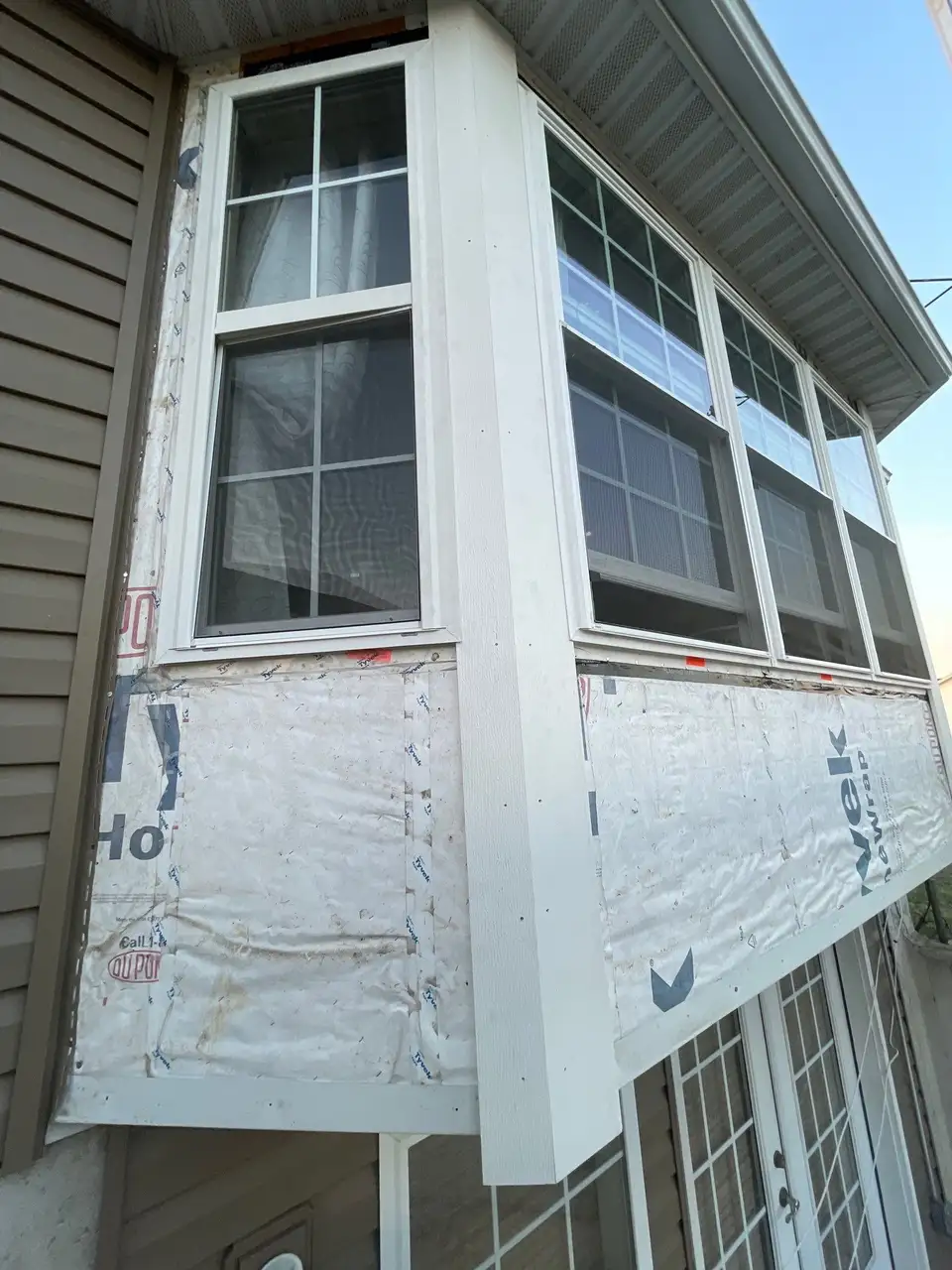
In Missouri, a standard-size vinyl replacement window installed typically costs $450 to $1,100 per opening; fiberglass and wood-clad windows run $900 to $2,200 or more. A whole-house project of 12 to 15 windows usually lands between $7,000 and $20,000, with full-frame installation, custom sizes, and specialty shapes pushing toward the top.
This guide breaks down what is inside those numbers, the difference between an insert and a full-frame replacement, the upgrades that pay back in our climate, and how to tell when a window needs replacing rather than a repair.
What drives the price per window
Window quotes are built from four inputs: the unit itself, the installation method, access, and finish work.
- The window. Frame material, glass package, size, and brand tier. A builder-grade double-hung and a triple-pane fiberglass casement can differ by a factor of four before anyone picks up a tool.
- Installation method. An insert (pocket) replacement keeps the existing frame; a full-frame replacement removes it down to the rough opening. Full-frame costs more and fixes more.
- Access and floor. Second-story windows, windows over a porch roof, and anything that needs staging cost more in labor.
- Finish work. Interior trim, exterior capping with aluminum coil, and any rot repair found once the old unit comes out.
The rot line item surprises people. In our area, the bottom of a window opening on the weather side is where water has been sitting for years. If the sill or framing is soft, it has to be rebuilt before the new window goes in. That is not padding; it is the difference between a window that lasts 30 years and one that leaks in five.
Cost by frame material
- Vinyl: $450 to $1,100 installed. The most common choice, no painting, good insulation. Quality varies a lot between lines; welded corners and reinforced meeting rails matter.
- Fiberglass: $900 to $1,800 installed. Stronger and more stable than vinyl in temperature swings, paintable, longer warranties. A good fit for the freeze-thaw cycles here.
- Wood and clad-wood: $1,000 to $2,200 or more installed. The look for older and higher-end homes; aluminum or fiberglass cladding on the exterior keeps maintenance down.
- Aluminum: $500 to $1,200. Slim frames, but poor insulation without thermal breaks; rarely the right choice for a Missouri house.
Insert vs full-frame replacement
An insert replacement slides a new unit into the existing frame after the sashes are removed. It is faster, cheaper, and keeps the interior and exterior trim. The trade-off is a slightly smaller glass area and a dependence on the old frame being square, dry, and sound.
A full-frame replacement takes the opening back to the studs. You get new flashing, insulation around the frame, a new sill, and the maximum glass size. It is the right call when the old frames are rotten, when you are changing window size or style, or when the house is getting new siding at the same time. If siding replacement is on the horizon, coordinating the two saves a second round of exterior trim work.
Expect full-frame to add $150 to $400 per window over an insert, more if trim has to be rebuilt.
Cost by window style
- Double-hung: the baseline; most quotes are priced around it.
- Slider: similar to double-hung, sometimes slightly less.
- Casement and awning: 15 to 30 percent more; better air seal because they crank shut against the frame.
- Picture (fixed): less per square foot of glass, but large units cost more to handle.
- Bay and bow: $2,500 to $7,000 or more; they are a small construction project with a roof and support.
- Egress windows for basements: $2,500 to $6,000 including excavation and well; required for bedrooms under most codes.
Energy savings in Missouri
Missouri sits in a mixed climate: real winters and humid, hot summers. Look for a low U-factor (0.30 or under) for winter heat retention and a moderate solar heat gain coefficient for summer. Low-E coatings and argon fill are standard on any window worth buying. Triple-pane adds $100 to $300 per window; it helps most on north-facing rooms and for noise, and less on payback math.
Be realistic about savings. Replacing single-pane windows with modern double-pane units can cut heating and cooling costs meaningfully. Replacing 15-year-old double-pane windows saves much less, so the case there is comfort, drafts, condensation, and failed seals, not the utility bill. Federal tax credits for qualifying ENERGY STAR windows have been available in recent years; confirm the current rules with your tax preparer before counting on them.
Repair or replace?
Replace when you see fog between the panes (a failed seal), frames that are soft or warped, sashes that will not stay open, drafts you can feel with the window closed, or single-pane glass. Repair when the problem is a broken balance, a worn weatherstrip, a cracked pane in an otherwise sound unit, or a screen. A contractor who does both, like A&S Contracting Services, has no reason to push replacement when a $150 repair solves it.
One more reason to replace: rot at the sill that has spread into the wall. That job crosses from windows into siding and framing, and it is where a general contractor that self-performs the whole exterior, including soffit and fascia and siding, saves you from coordinating three companies.
Pricing new windows?
A&S Contracting Services measures every opening and gives you a written, per-window estimate for vinyl, fiberglass, or wood, insert or full-frame. Free across Warren County and our 50-mile service area.
Call (636) 359-7204Frequently asked questions
How many windows can be replaced in a day?
A crew doing insert replacements typically installs 8 to 12 windows a day on a single-story home. Full-frame replacements with trim work run 4 to 8 per day. Most whole-house projects finish in one to three days.
Is it cheaper to replace all windows at once?
Usually, yes. Setup, staging, and disposal are shared, and manufacturers price better on volume. Splitting the house into two phases is reasonable if budget requires it; do the weather side or the worst windows first.
What is the best time of year to replace windows in Missouri?
Spring and fall are most comfortable, but windows are replaced year-round. Each opening is exposed for well under an hour, so winter installs are common and sometimes come with better scheduling.
Do replacement windows need a permit in Warren County?
Like-for-like insert replacements often do not, but full-frame replacements and any change in opening size or egress requirements may. We confirm the requirement with the local building department before the job starts.